
Prototyping the Future, One Tool at a Time: MIT's Center for Bits and Atoms
1st Jul 2026
CAMBRIDGE, Massachusetts —
At MIT’s Center for Bits and Atoms (CBA), the distance between a digital idea and a physical object is meant to be as short as possible. That philosophy shapes research across CBA, from digital fabrication and machine prototyping to electronics. As Quentin Bolsee, a research scientist at CBA, puts it, “It's really anything that can transform digital designs into a physical product.”
CBA goes in the other direction too, turning physical things into digital information, but fabrication is at the heart of much of its work. “We mostly go from bits to atoms,” Bolsee says. “We fabricate things.”

Quentin Bolsee came to the Center through the FabLab network, after studying electrical engineering and completing his PhD in Brussels. Alan Han studied electrical engineering at Purdue University, worked for roughly six years at connector manufacturer Molex, and eventually returned to school at MIT.
Today, Bolsee and Han approach fabrication from different but complementary directions. Bolsee is focused on making machines easier to prototype, while Han is exploring what an end-to-end electronics prototyping process could look like and developing a modular electronics system that could make circuits more composable.
For both, the goal is to make it easier to turn an idea into something real and tangible.
From Rapid Prototyping to Complete Electronics
Bolsee's research stems from a problem he encountered firsthand. During his PhD, he wanted a more hands-on way to build the machines he needed for his research and began working in a makerspace in Brussels, eventually connecting with MIT’s CBA through the FabLab network. Today, he is working to make specialized machines easier to prototype by developing modular machine components that can be fabricated and shared, allowing researchers and makers to assemble specialized machines without starting completely from scratch.
“What we find is in FabLabs, we have existing equipment that's a little hard to modify,” Bolsee explains. “And then you have purely custom equipment that's used for extremely specific processes that ... only a handful of people would care about and there's some frustration in prototyping the machine itself, so I want to make it easier for people to get there.”
MIT’s Center for Bits and Atoms already has tools that make mechanical prototyping relatively accessible. The lab uses 3D printers, laser cutters and CNC machines, while its researchers have also developed methods for rapidly fabricating circuit boards.
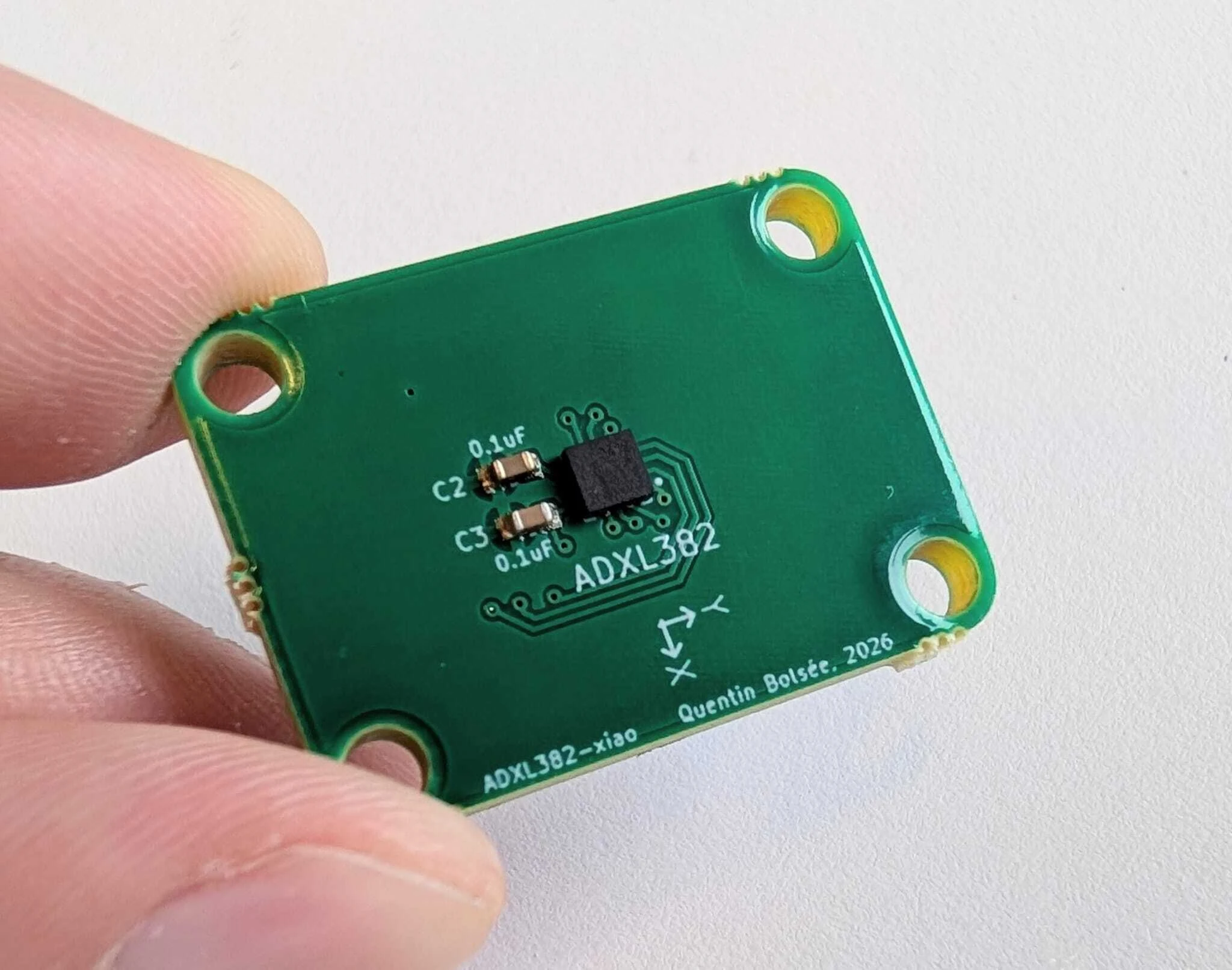
During a conversation with the Neoden USA team, Bolsee showed an example of a circuit board created by laser engraving. The laser removes copper to form the circuit, producing a board in roughly 10 minutes. “So we think that's a pretty big deal,” he says.
Making the bare board, however, is only one part of the challenge. As Han explains, the next steps still involve applying solder paste, manually placing components, and soldering the finished board. That led to a broader question in Han's research: what would the “3D printer” of end-to-end electronics assembly look like? Instead of just building a bare circuit board, he’s interested in a system that could produce a finished, usable circuit, “...like the machine that doesn't just make the circuit board but then spits out a finished circuit that you can use for something,” says Alan Han. His modular tile system is one attempt to answer that question.
Building Circuits from Modular Tiles
Alan Han's research uses small PCB tiles that can be assembled into larger electronic systems. The current tiles are roughly 6 by 6 millimeters and carry different patterns. Once the tiles are punched out, they can be composed in three dimensions in a stacking, tessellated arrangement to create an arbitrary electronic circuit.
At one end, the system is designed to make electronics prototyping more robust. Alan Han explains, “There’s both the literal application of this system, which is, we have the snap-together circuits, we have breadboards. How can we take that prototyping process and make something that’s a little more robust at the end of it?”
At the other end, Han asks, “How far can we go with this idea with respect to real-world applications?” He and collaborators in MIT’s Department of Electrical Engineering and Computer Science (EECS) are exploring micrometer- and eventually nanometer-sized tiles.
The assembly process is also part of the research challenge. In the current system, solder is applied to each tile before the pieces are assembled into a layered structure and run through reflow again. That repeated reflow step is one reason a controlled, repeatable reflow process is important to Han’s workflow. Earlier versions also explored reversible interconnects, opening the possibility of circuits that can be taken apart and recomposed without sacrificing the performance of a conventional circuit.
“Like Legos, you don't really throw Legos away. If you're done with them, you take them apart, you build something new,” Han says. “But the idea is to retain performance of a normal circuit…”
Han makes the concept sound simple, but actually building it presents a much more complicated challenge.
From Makeshift Reflow to a Repeatable Process
Turning Han's tile concept into a physical circuit requires several fabrication steps, and reflow is particularly important. The routing tiles require solder on both sides, while some versions also incorporate devices.
Han uses solder stencils extensively and a pick and place machine for some component placement, and is deliberate in his solder paste selection. “So I use SAC305 for the devices, and then I use the low-temperature solder paste for the pads,” Han explains. “It's to make sure, since it's going through multiple reflow cycles… that the devices don't fall off of the tiles.”
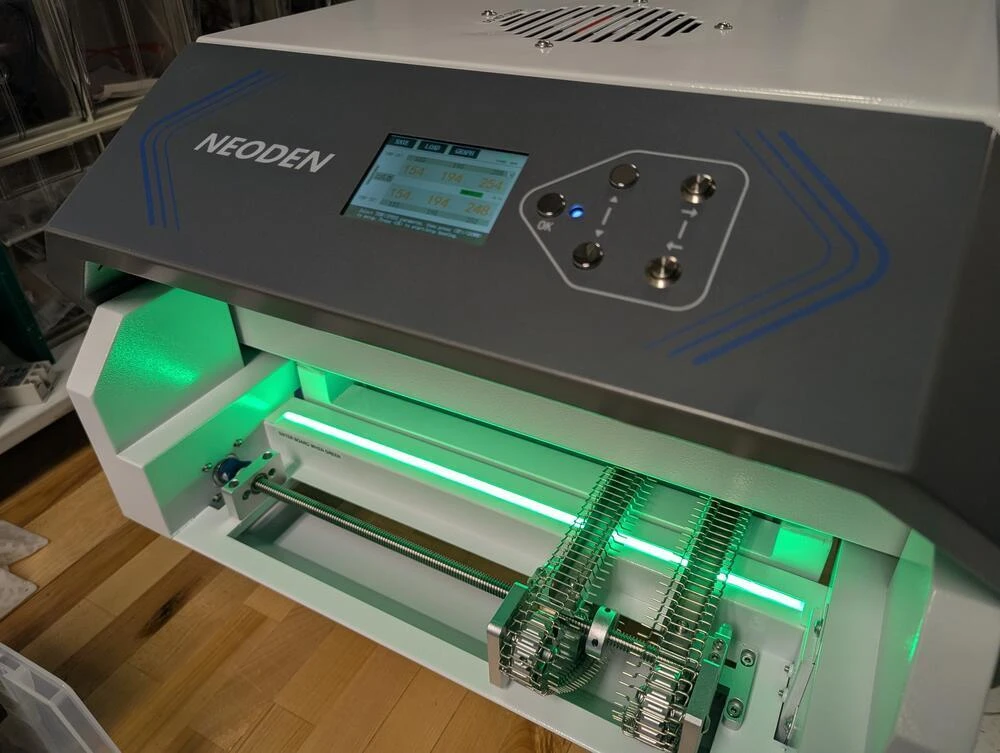
Before CBA acquired the Neoden IN6C, Han experimented with hot air, a hot plate and eventually a toaster oven. Reflowing the double-sided tiles required him to build makeshift platforms from screws, standoffs and nuts so the board could be reflowed properly. The setup worked, but processing large batches required a lot of repeated manual setup. The conveyorized IN6C reflow oven gave Han a more practical approach.
“IN6C has been very helpful because I don't have to use hardware to make sure that both sides are exposed and able to reflow without, you know, touching something that shouldn't be,” Han says.
Instead of arranging boards inside a static oven, Han can continuously feed his small panels onto the conveyor as space becomes available. For his low-temperature process, he developed a custom profile by attaching a thermocouple to a board and making test runs while adjusting the temperature settings and conveyor speed. After tuning the process, Han brought the indicated run time to roughly four minutes and has been able to keep multiple small panels moving through the oven at once.
“So I think it was a combination of new solder paste and the oven,” Han says. “The quality control has dramatically improved for sure on my end.”
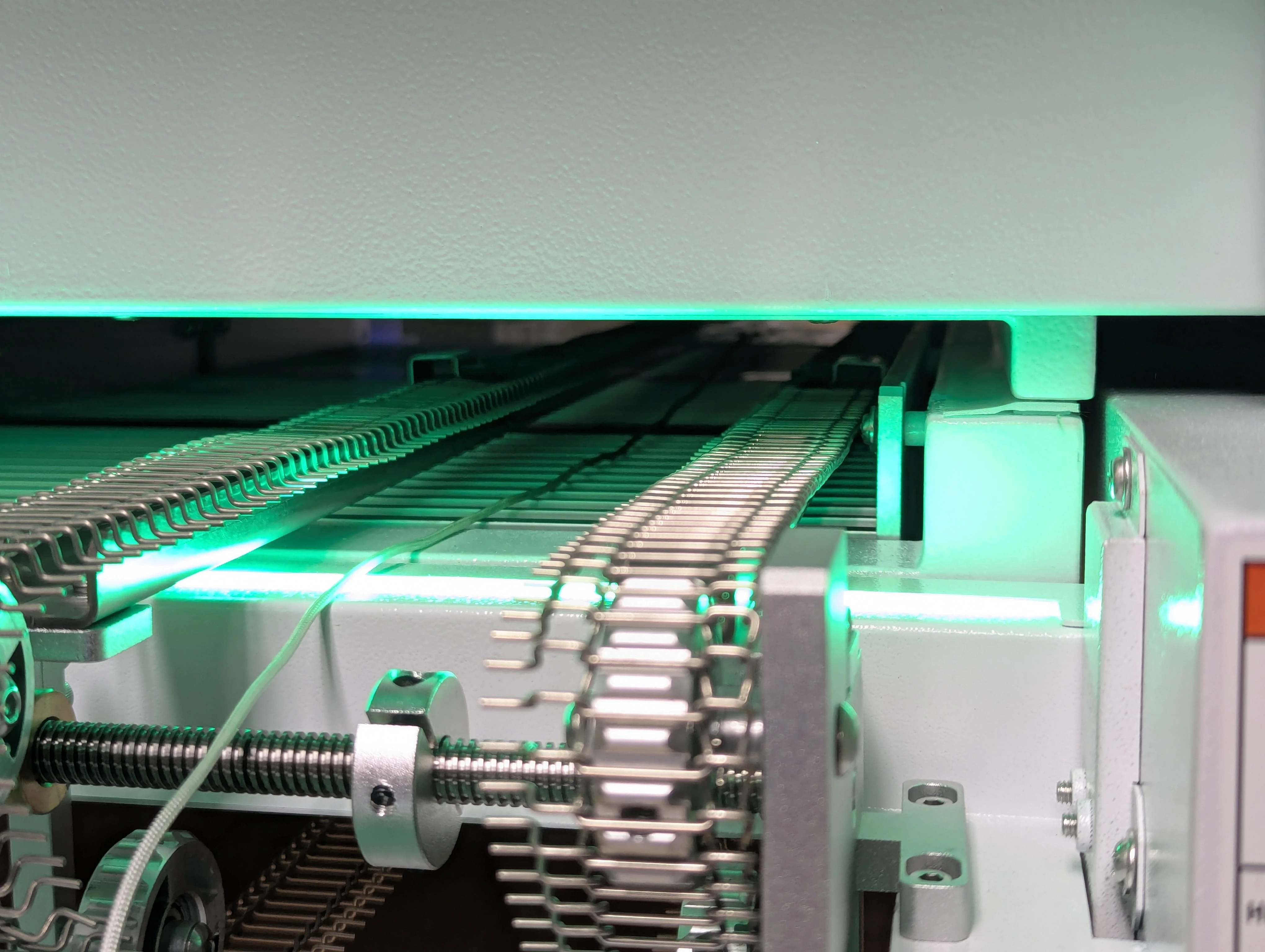
Quentin Bolsee has also used the IN6C for more conventional SAC305 assemblies and found the experience straightforward. For CBA, the flexibility around experimental processes and simple operation for conventional ones is especially useful in a lab where no two projects necessarily look alike.
Making More Ideas Practical
Research doesn't always follow an exact schedule. For Han, research builds can range from 10 to 20 panels, while one particularly intensive build involved 43 panels. Having the IN6C reflow oven makes part of that process considerably easier to manage.
“Because I have to go through so many different steps, it's really nice that [the IN6C] streamlines this one part of the process for me.”
That becomes more important as quantities increase. Han described potential projects involving hundreds of circuit boards, including PCB conference badges. For production at that scale, he says an in-house conveyor oven would be essential: “I wouldn't consider it otherwise."
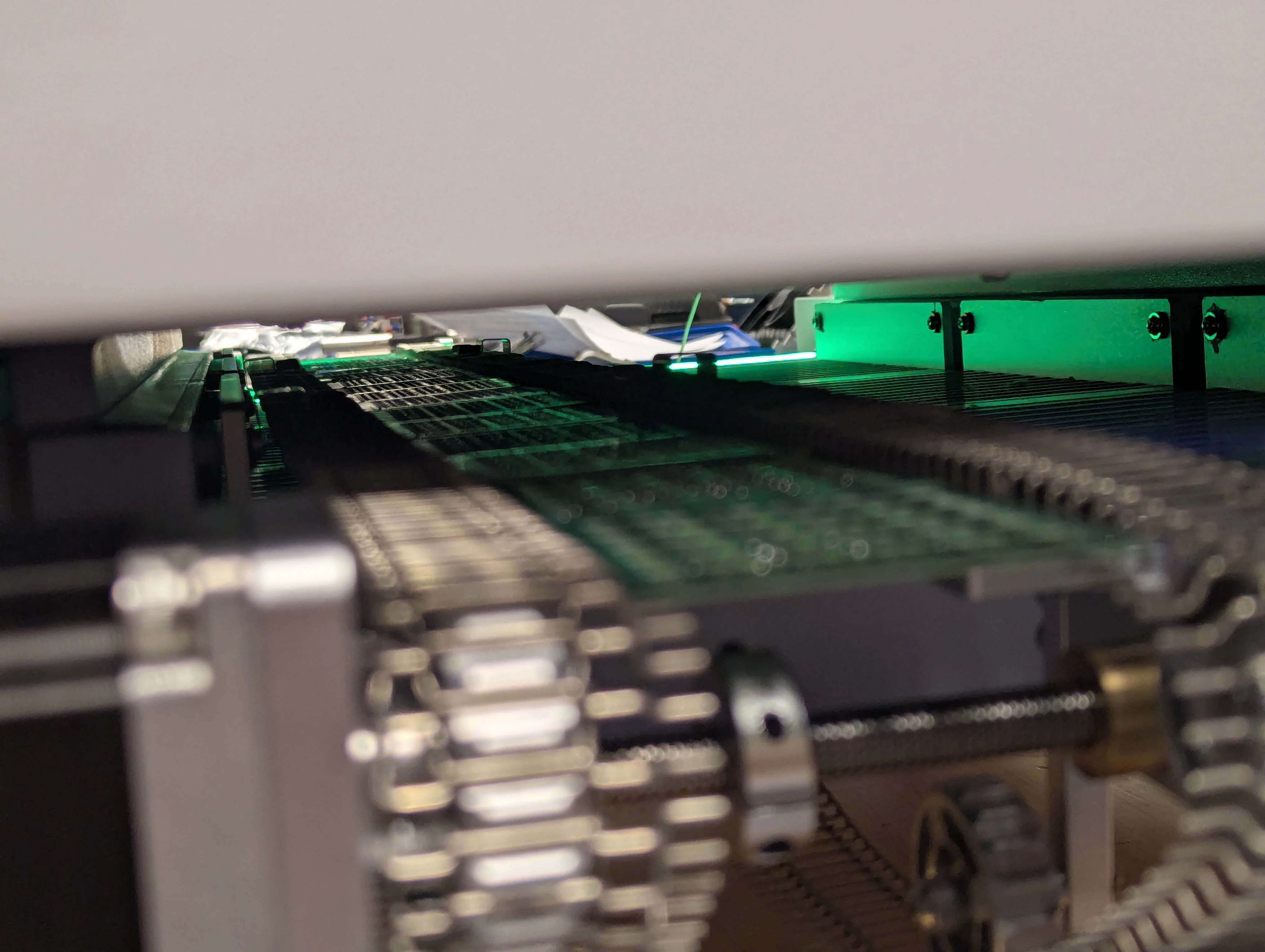
Bolsee sees similar potential in his own machine-prototyping work, where he builds electronic modules that can become reusable components of larger machines. “I could see myself making maybe four times the amount of boards I usually do,” he says. “Usually we make maybe 20 of those, but I could see myself making a lot more of these, thanks to that, because it's really painless.”
That same capability could eventually have an impact beyond CBA's research projects.
Each fall, CBA teaches How to Make Almost Anything, a hands-on course covering fabrication processes including 3D printing, laser cutting and PCB design. The lab can already move quickly from a digital circuit design to physical fabrication, and reflow soldering could become another piece of that workflow. The IN6C currently sits in CBA's research lab rather than the public space used for teaching, but Bolsee sees potential in making a tool like it available directly to students.
“It would change the way we teach the class if we had that tool in the public space that we use for teaching,” he says. “That would be a game changer, I think.”
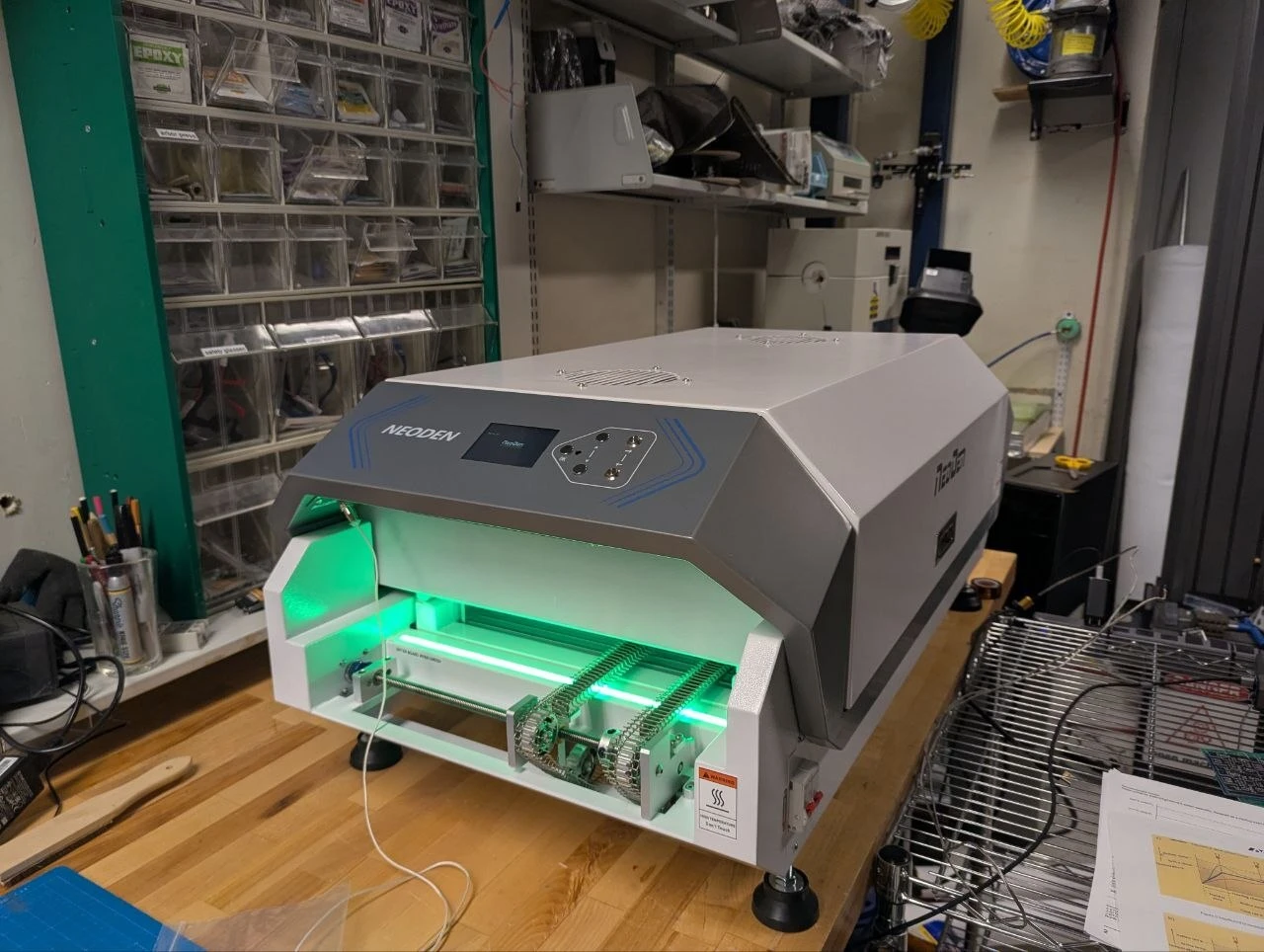
For Neoden USA, that’s an exciting possibility. Making professional SMT assembly equipment accessible to students gives them hands-on experience with processes and tools that extend beyond the classroom. It's also an idea that fits naturally with CBA's broader goal of reducing the distance between digital designs and physical things. When circuit fabrication, stencil production, assembly, and reflow can all happen within the same environment, students and researchers can spend less time waiting on the fabrication process and more time testing what they've made.
A Shared Interest In Better Tools
Working with the IN6C has also given Han and Bolsee ideas about what the next generation of accessible reflow equipment could look like. During their conversation with Neoden USA, Han and Bolsee discussed possibilities ranging from a smaller conveyorized oven for makerspaces, to greater computer connectivity, easier data collection, and more sophisticated feedback and control.
For Bolsee, expanding the machine’s computer-control capabilities could allow researchers to do more than simply record what's happening inside the oven.
“The interest is not just recording data, but also acting on the machine,” he says. “If the computer can close the loop at a really high level, you'll find some people doing some really smart stuff with that, I think.”
For Neoden USA, conversations like these offer an opportunity to see how equipment performs in unconventional research workflows, hear directly from people using it, and learn what capabilities could make electronics fabrication even more accessible.
What Comes Next
For Han and Bolsee, that question of accessibility is closely connected to what excites them about the future of electronics fabrication.
Bolsee points to how quickly the gap between a digital design and a physical circuit board is closing: “Just the idea that you can literally design and make a board in, like, an hour,” he says. “It's totally realistic now. I think that's a game changer. It's extremely recent that it happened.”
For Han, those advances open the door to asking what else could become possible at the desktop scale. Current rapid-prototyping methods at CBA have largely focused on one-layer boards, but he sees opportunities to expand those capabilities and is particularly interested in where three-dimensional electronics could go next.
“I'm personally… interested in how 3D electronics might develop too,” Han says. “There's a lot of cool ways to put conductors on plastic using lasers, for example.” Those possibilities connect directly back to the research already being explored at CBA.
For Han, the tile research continues toward more sophisticated assemblies and a better understanding of how modular electronics can move from individual research prototypes toward broader applications.
For Bolsee, the work continues toward making machines easier to prototype and share, extending the philosophy of the FabLab network into increasingly capable fabrication systems.
Across CBA, Han and Bolsee estimated that roughly five to 10 people are working in the area at a given time, with around 20 major projects happening simultaneously. Some projects last years; others can be completed in a semester or even a matter of days.
When a research environment is built around turning ideas into physical things, the tools that sit between design and reality can determine how quickly researchers can iterate, how many prototypes they can build, and which ideas are practical to pursue. As CBA continues exploring new ways to turn bits into atoms, Neoden USA is proud that the IN6C has become one of the tools helping bring those ideas to life.